OHS Budget 2026: How to Present It So It Gets Approved
30-second summary
· OHS should be among the most defensible budget items, because it protects the most valuable asset: people.
· An Occupational Health and Safety (OHS) budget gets approved when it can be understood quickly and governed with data.
· To have data, you need tools (ideally digital) that record evidence and enable continuous tracking — not “scattered Excel files.” The right occupational risk prevention software makes this evidence easy to capture and audit.
· Every action (training sessions, campaigns, new PPE, inspections, etc.) must clearly connect investment with impact: what it reduces, how it is measured, and when we expect to see signals.
· If an OHS initiative cannot be integrated, scaled, and automated, it rarely becomes consolidated as a strategic investment.
Why do so many proposals fail to get approved, and what are they missing to become budgetable?
Pablo R. Nieto:
In the end, the rules are the same for everyone. If a proposal is based on assumptions — “We believe that…”, “The competition is already doing it…”, “I heard it at a conference…” — that is not a budget: it’s a hypothesis. And hypotheses can only be approved when they are turned into something measurable (with data) and manageable. Strong proposals lean on hard data such as key safety KPIs rather than assumptions.
If an initiative is well designed, it should be possible to summarize it like this:
We invest in X to reduce Y, and we will measure it with Z.
And here is the critical point: usually the unknown is not X or Y. The unknown is Z. In other words: with which tool and with which system are we measuring the return (or the avoided cost) of our OHS initiatives?
It is not enough
to ask for resources: every request must explicitly connect the investment with the expected impact and explain how it will be verified (indicator, data source, and tracking frequency).
What marketing teaches us about proper measurement (and why OHS should copy it):

Without traceability, analog falls behind.
TV and paper give way to digital.

Real-time data.
This is how advertising investment evolved.
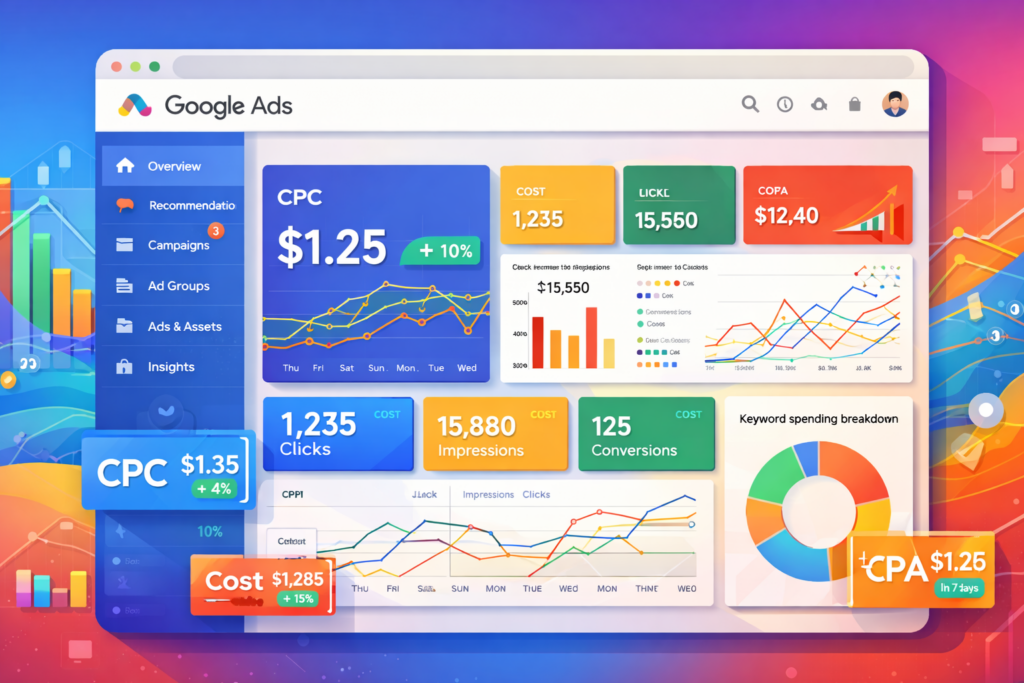
In marketing, the classic “we want to launch this campaign because we believe…” stopped working a long time ago. Today, we talk about CTR, CPC, impressions, or engagement, and those indicators are easily compared against:
- The market
- The sector
- The company’s own historical data
If CPC exceeds the margin, the campaign is adjusted or stopped. Not because of a lack of belief, but because there is measurement and clear decision criteria.
The good news for occupational health and safety
From a financial point of view, there is a simple idea that is often forgotten: capital is always allocated where the risk to value is concentrated. Framing the spend as protection of people reinforces a genuine safety culture at leadership level.
In most companies, the biggest cost (and also the biggest productivity lever) is people. That’s why investing in well-governed OHS is not only an ethical preference: it can also be a rational financial decision.
Put another way:
- If you protect people, you reduce disruptions, turnover, absenteeism, and reactive costs.
- If you reduce incidents and recurrence, you stabilize operations.
- And if you also digitalize, you can scale control with less friction.
Capital is allocated where the greatest risk to value is concentrated.
Protecting people is not an operating expense: it is a real driver of productivity, stability, and business scalability.

Data = budget
Without data, there is no traceability. Without traceability, there is no investment.

The operational soul of the organization: our financial checklist
We jointly review each budget item with the different departments using a checklist that, for me, is the “operational soul” of the company — in other words, what we truly prioritize when it comes time to allocate resources.
1. Reputation and ethics
Our first filter, above all else, is whether the initiative fits with what the company is willing to stand behind. In our case:
Ethics is a strategic criterion.
A real example (one of many we could share): at one point we turned down a large project with a betting and gambling group to “improve the ergonomics” of their slot machines. It was money and could have opened doors to more projects, but we did not want to contribute to helping people with an addiction sit longer because they got tired less. There is no return that compensates for that reputational risk and that inconsistency.
2. Traceability and evidence (data)
If I cannot answer “How am I going to prove this works?”, then it’s not ready. You need KPIs (what we measure), data sources (where it comes from), tracking frequency, and at least a basic baseline (where we start from).
“Without data, you’re just another person with an opinion.”
— Attributed to W. Edwards Deming.
3. Expected impact
This is where return comes in: we prefer a conservative, defensible impact over an overly optimistic promise. We are especially interested in reviewing the cost of inaction: what does it cost to do nothing? (lost time, interruptions, rework, reactive costs, penalties, etc.).
4. Automation and scalability
If an initiative can be supported by digitalization (for example, capturing evidence, automating follow-up, centralizing KPIs), it is usually more governable and scalable. Not for the sake of “modernity,” but because it reduces friction, dependence on scattered Excel files, and information loss.
5. Fit with core strategy
The question is: does this integrate into how the company operates, or is it an “extra” that lives on the side? What does not fit into daily operations dies when priorities change.
6. Execution and control plan
For us, this is key: owner, milestones, timeline, and a minimum follow-up plan. If there is no one responsible and no defined review point, there is no management control.
7. External providers (make vs. buy)
If it comes from a consultancy or external provider, we need clarity: what part is a one-off service and what part stays in-house? If it adds value, we want to see a short-term internalization plan so we are not permanently dependent on third parties.
In summary: an OHS budget for 2026 gets approved when it stops sounding like a “necessary expense” and starts being presented as a governed investment (data, mechanism, and control).
Sabentis Written Interviews 2026
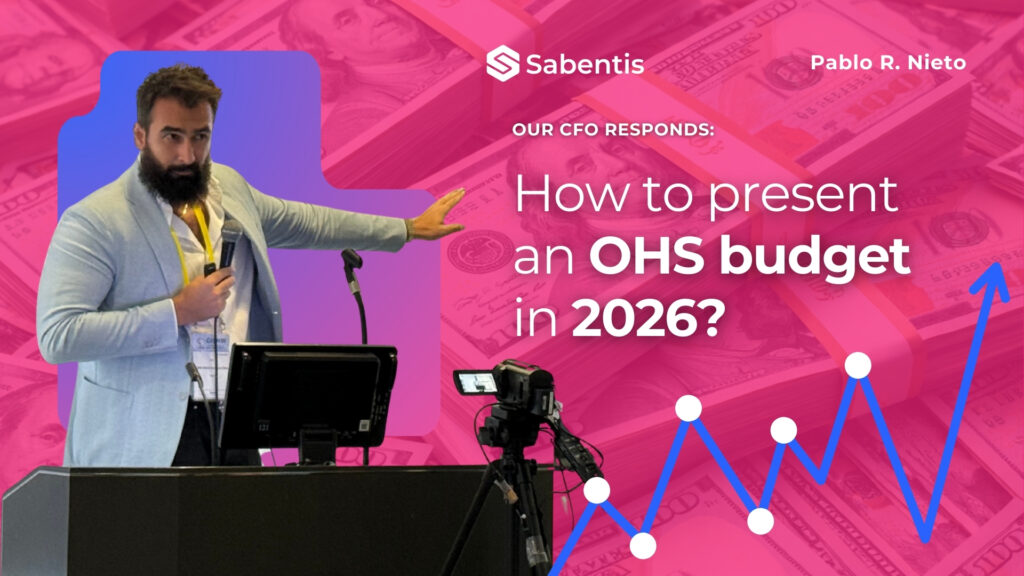
Pablo R. Nieto
CFO Sabentis & Executive Vice President ORP
In this Q&A-style interview, Pablo R. Nieto, CFO of Sabentis and Executive Vice President of the International ORP Foundation, explains how to build an OHS 2026 budget that is truly approvable from a 100% financial and executive perspective.
Throughout the conversation, he explains how to translate OHS investment into KPIs and measurable results, how to define milestones that allow investment to be released with control, and why OHS digitalization and the use of software like Sabentis are key to generating traceability, evidence, and continuous improvement.
What should you prepare before the meeting so that approval of the OHS budget doesn’t depend on “convincing” people in the room?
The decision is not made only in the meeting; it is prepared beforehand. A budget is approved more easily when you arrive with clarity, evidence, and a control framework that reduces the perceived risk for Management and Finance.
I recommend three very concrete actions beforehand:
1) Send a one-pager 48 hours in advance
A one-page summary including: what is being requested, why now, what changes, key KPIs, milestones, and how execution will be controlled. This allows the meeting to be about decisions, not discovery.
2) Do a pre-brief with the decision-maker or key influencer (15 minutes)
A short prior meeting to validate the approach, resolve objections, and ensure the message aligns with management criteria.
3) Ask the question that changes everything
Before defending anything, ask:
“What evidence do you need to say yes?”
This turns the conversation into an approval checklist, not a debate of opinions.
A financial negotiation trick: approve by gates
Instead of asking for “the entire annual budget” upfront, propose approving Gate 1 (the first milestone) with a mandatory review at 45 days. This reduces friction, lowers perceived risk, and speeds up the “yes,” because the decision becomes incremental and controlled.
Mistakes that get your budget cut
- Activity ≠ impact: Saying “we’ll do more training” or “we’ll do more inspections” is not enough if you don’t explain what behavior will change and how you’ll measure it.
- No real owners: If everything “depends on OHS” and no one in operations takes ownership, the plan is perceived as hard to execute and gets cut.
- No review calendar: Without a follow-up rhythm (monthly, by milestones, etc.), the budget loses focus and stays on paper.
- Inflated ROI: An inflated return kills credibility. A prudent, defensible case based on data is better.
- Ignoring operational load: What doesn’t fit into the shift doesn’t exist.
Recommended sources
- Prevención Integral (canal ORP): paper sobre digitalización en salud ocupacional
- Digitalización + IA aplicada aSST
- INSST: Análisis de escenarios futuros y prioridades para gestionar la transformación digitalen España (Año 2025)
- OIT/ILO (noticia): “AI and digitalization are transforming safety and healthat work”.
- ISSA (World Day OSH 2025): IA y analítica en tiempo real.
FAQ
How many initiatives should an OHS 2026 budget include?
Ideally 3 to 5 clear, measurable, and controlled initiatives rather than a long list. The rest can remain as a backlog conditional on milestones, to avoid an “opinion-based” and hard-to-execute budget.
Which metrics help Finance and Management the most?
Combine 3–6 KPIs with a defensible baseline: severity/lost days, frequency, % of actions closed on time, recurrence, and coverage of critical inspections. Add “real execution capacity” (hours and owners), because without capacity the plan is not financeable.
How do you justify the budget without inflating ROI?
By using a conservative total cost of risk and presenting scenarios (conservative, realistic, and aspirational). Credibility weighs more than a spectacular Excel file: management trusts more when you incorporate uncertainty and define how it will be controlled.
Why are stage-gates important?
Because they allow approval by milestones, early signals, and the ability to continue/adjust/stop based on data. That reduces risk for those who have to approve budgets.